
Monolithic vs Microservice: To split or not to split
A guide to help choose the best architectural pattern for your business

Having emerged in the late 2000s, microservices are still very much in the limelight today. Undoubtedly, the microservices approach brings forth tangible benefits, such as scalability, flexibility, agility, and other notable advantages. Companies such as Google, Amazon, Netflix, Uber, and other technology pioneers have successfully transitioned from a monolithic architecture to microservices, demonstrating the efficacy of this architectural style. This raises the architectural question: Is a Monolithic or Microservice architecture a good choice for our business?

As pointed out by Kent Beck the answer must start with “It depends…” because both approaches have their own set of advantages and disadvantages. In this article we will try to shed some light on the differences and provide some guiding principles for which architecture to choose.
The Pros and Cons of a Monolithic and Microservice Architecture
In considering the architecture for your software system, understanding the pros and cons of both monolithic and microservice approaches is important. Each has its own set of advantages and disadvantages that can significantly impact your project’s success.
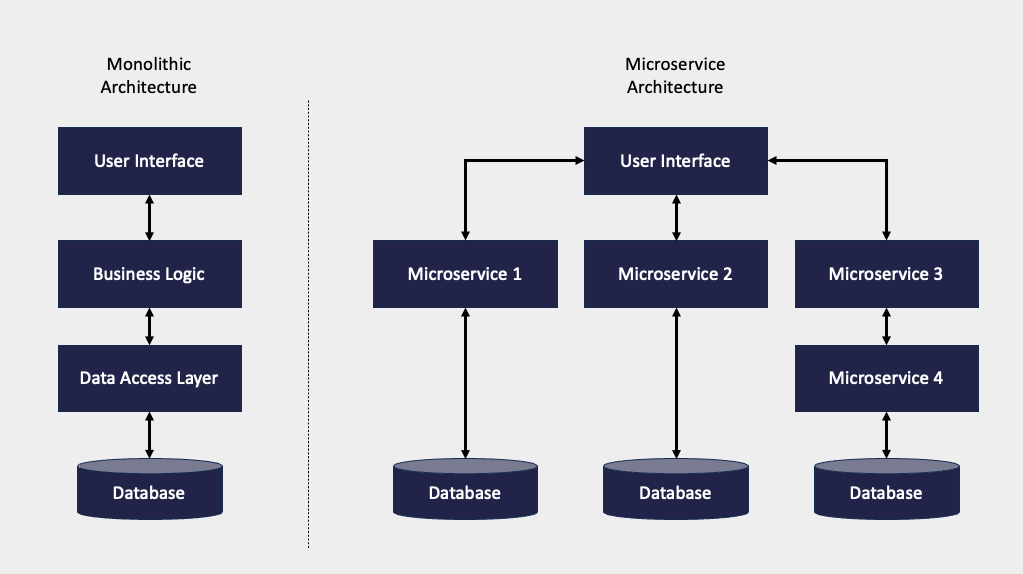
Monolithic architecture
In a monolithic architecture, the software application is built as a single, tightly connected unit. All the different components, such as the user interface, business logic, and database, are bundled together within a single codebase. It’s like a big, self-contained structure where all the parts are dependent on each other. Changes or updates to one part can impact the entire system. Think of it as a big block of LEGO bricks stuck together, where you can’t easily separate or modify individual bricks without affecting the whole structure.
Advantages
Simplicity: Monolithic architectures are relatively simpler to develop, test, deploy, and maintain compared to microservices. They have a single codebase, making it easier to understand the system as a whole.
Performance: Monolithic architectures can have better performance in certain cases due to direct method calls within the codebase, without the overhead of network communication between services.
Development Speed: Building features and making changes in a monolithic application can be faster as there is no need to manage multiple services or their intercommunication.
Easier Debugging: Debugging can be simpler in monolithic architectures as the entire application runs in a single process, allowing for easier inspection of code and variables during runtime.
Reduced Complexity of Deployment: Deploying a monolithic application typically involves deploying a single unit, simplifying the deployment process compared to managing multiple services in microservices architecture.
Disadvantages
Scalability Challenges: Scaling a monolithic application can be more challenging as the entire system needs to scale together, even if specific components or functionalities require more resources
Lack of Technological Flexibility: Monolithic architectures often limit the ability to adopt new technologies or frameworks since all components of the application need to use the same technology stack
Team/Productivity Bottlenecks: Large development teams working on a monolithic codebase can face challenges related to parallel development, versioning conflicts, and dependencies, leading to potential bottlenecks and reduced productivity
Limited Fault Isolation: A failure or bug in one part of a monolithic application can potentially impact the entire system, making it more difficult to isolate and contain issues
Complexity and Maintainability: As a monolithic application grows in size and complexity, it can become harder to maintain, refactor, and introduce changes without affecting other parts of the system
Microservice architecture
Microservice architecture breaks down the software application into smaller, independent services. Each service focuses on a specific functionality, like handling user authentication or processing payments. These services communicate with each other through well-defined interfaces, like passing messages or using APIs. It’s like having separate LEGO bricks that can be connected and disconnected as needed. Each brick (service) can be developed, deployed, and scaled independently, allowing for flexibility and easier maintenance. If you need to change one brick, it won’t disrupt the entire LEGO creation.
Advantages
Scalability and Flexibility: Microservices allow for independent scaling of individual services based on their specific needs, providing better scalability and flexibility compared to monolithic architectures.
Technological Agility: Each microservice can be developed using different technologies, allowing teams to choose the most appropriate tools and frameworks for their specific requirements.
Improved Fault Isolation: In microservices, failures or bugs are generally isolated to specific services, reducing the impact on the entire system and enabling better fault tolerance.
Autonomous Development and Deployment: Microservices empower independent development teams to work on individual services, enabling faster development cycles, more frequent deployments, and greater agility in delivering features.
Modular and Maintainable: Microservices promote modular development, making it easier to understand, update, and maintain individual services without affecting the rest of the system. They also facilitate adopting modern software engineering practices like continuous integration and deployment.
Disadvantages
Increased Complexity: Microservices introduce additional complexity due to the distributed nature of the system, inter-service communication, and management of multiple services
Operational Overhead: Operating and managing a distributed system with multiple services can be more challenging compared to a monolithic application. It requires robust infrastructure, service discovery, load balancing, and monitoring solutions
Communication Overhead: Communication between microservices, typically through APIs or message queues, introduces potential latency and network-related issues that need to be managed
Distributed Data Management: Handling data consistency and transactions across multiple services can be complex, requiring careful design and implementation of strategies like eventual consistency or distributed transactions
Testing and Debugging Challenges: Testing and debugging in microservices architecture can be more intricate due to the need to understand and trace interactions across multiple services and potentially dealing with asynchronous communication and eventual consistency
Reasons for Adopting a Monolithic or Microservice Architecture
Potential reasons for going with Monolith
A monolithic architecture might be a good choice for you when:
The application is relatively “simple”: A monolithic architecture offers simplicity, making it easier to develop and maintain the application. For example, a corporate website, eCommerce solution can be efficiently built as a monolith without the need for complex distributed systems (depending on traffic and features)
If you need to launch an application fast: If your goal is to launch your application quickly and validate your business idea, a monolithic architecture can be advantageous. For instance, a startup developing a minimum viable product (MVP) may choose a monolith to quickly release their product and gather user feedback before investing in a more complex architecture
You have a “small” development team: If your development team is small and closely acquainted with the entire codebase, a monolithic architecture can be advantageous. This familiarity allows for efficient collaboration and easy coordination among team members. For example, a small team of developers working on an internal tool may find it more productive to maintain and enhance a monolithic application rather than dealing with the complexities of microservices
Your monolith is modular: If your monolithic architecture already exhibits modularity, with well-organized code divided into individual feature modules, there are benefits to sticking with it. This modularity allows for easier maintenance, updates, and scalability within the monolith. For example, a content management system with separate modules for user management, content creation, and analytics can effectively leverage the modularity of a monolithic architecture without the need for a transition to microservices
Potential reasons for going with Microservice
A microservice architecture might be a good choice for you when:
You need a scalable and flexible application: Microservice architecture allows for independent scaling of individual services, enabling better resource utilization and the ability to handle varying loads. For example, an e-commerce platform can scale its product catalog service separately from the user authentication service during peak shopping seasons, ensuring optimal performance.
You need to use a diverse tech stack: Microservices offer the freedom to use different technologies, programming languages, and frameworks for each service. This allows organizations to leverage the best tools for specific tasks. For instance, a travel booking platform may use Python for its A.I. fraud service and C# for its payment service, maximizing the strengths of each technology.
The complexity is too high for one team to manage: If the complexity of your application has reached a level that is challenging for a single development team to handle, adopting a microservices architecture can be beneficial. Splitting the application into smaller, manageable services allows different teams to focus on specific areas of expertise. For example, a large e-commerce platform with multiple functionalities such as inventory management, payment processing, and order fulfillment may require separate teams to handle each service effectively.
You want to increase fault tolerance and resilience: Microservices provide better fault isolation, meaning if one service fails, it doesn’t bring down the entire system. This promotes resilience and prevents cascading failures. For example, a social media platform can ensure that a bug in its messaging service does not impact other functionalities like posting updates or user authentication.
It’s important to note that while monolith and microservices offer several advantages, they also introduce additional challenges, which need to be carefully managed. The decision to choose either architecture should be based on the specific requirements, scalability needs, and organizational capabilities.